
Zebra 220Xi4 Discontinued: Why the TSC T8000 Is the Only Real Replacement for 8-Inch Wide Format Printing
Posted by Advanced Automation on May 13th 2026
By Advanced Automation, Inc. | Wide Format Printing | Printer Migration Guide
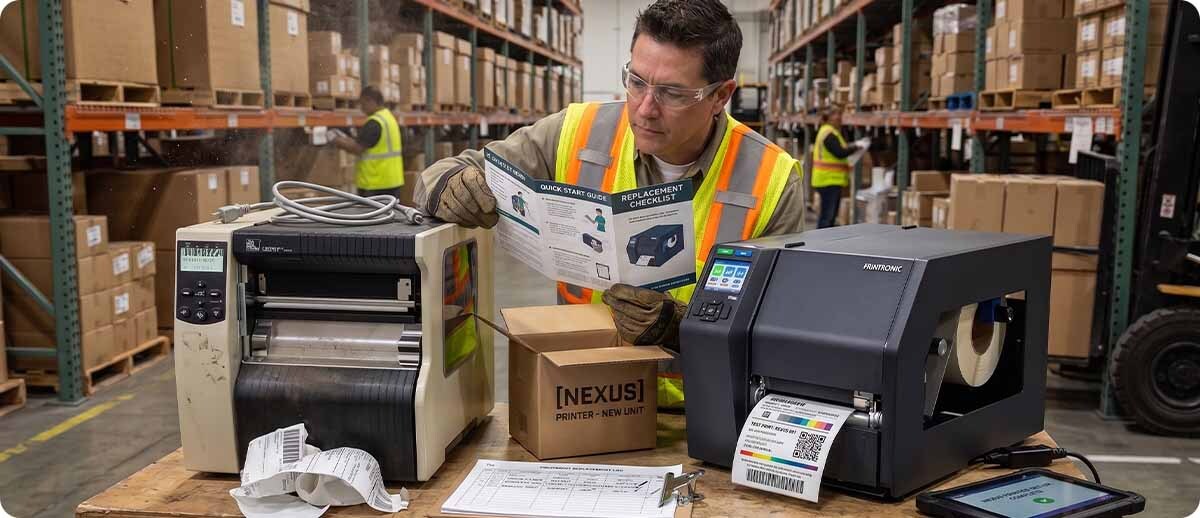
The Zebra 220Xi4 has been a workhorse for chemical drum labeling, pallet labels, GHS compliance labels, and wide-format shipping documentation for a long time. Operations that have run it know why it earned that reputation: it is built to last, prints reliably at high volumes, and handles the 8-inch wide media that most other industrial printers cannot touch. The problem is that Zebra has discontinued the platform and has no current production printer that fills that 8-inch niche. That is not a minor gap in the lineup. For the operations that specifically need wide-format printing, it means the 220Xi4 fleet is now in a countdown.
This matters for two categories of operation. The first is the operation running 220Xi4 printers today, watching them age, and planning a replacement strategy before a hardware failure forces the issue. The second is the operation that needs to add wide-format printing capacity and was planning to deploy 220Xi4 units, only to discover the product is no longer available as a current production item. Both situations point to the same answer: the TSC Printronix T8000 series.
Advanced Automation has been recommending and deploying the T8000 series as the replacement path for 220Xi4 operations. This guide explains why that recommendation makes sense technically, what the T8000 brings to the table that the 220Xi4 did not, how the migration from ZPL to T8000 emulation works in practice, and which T8000 configurations are available for the specific wide-format printing requirements that drove 220Xi4 deployments in the first place.
Why There Is No Zebra Replacement for the 220Xi4
This question comes up every time the 220Xi4 discontinuation is discussed, and the answer is straightforward. Zebra's current industrial printer lineup tops out at 6 inches of print width. The ZT610 and ZT620 are both 4-inch printers by print head width, and the ZT620 is Zebra's 6-inch wide format printer with a maximum print width of 6.6 inches. The 220Xi4 printed up to 8 inches wide. That 1.4-inch gap between 6.6 and 8 inches is the entire problem.
For most labeling applications, 6 inches is more than adequate. Shipping labels, compliance labels, and most product identification labels fit within 4 to 6 inches of print width without any compromise. But there is a specific category of application where 8-inch wide format is not a preference but a requirement. Chemical drum labels under GHS standards, full-face pallet labels covering a wide surface area, wide shipping documentation that must carry large barcodes alongside substantial human-readable content, and wide-format equipment tags all drive the need for print width beyond 6.6 inches. Zebra built and sold the 220Xi4 for exactly those applications. By discontinuing it without a replacement at that print width, Zebra has left those operations without a path within the Zebra ecosystem.
The support window for existing 220Xi4 hardware is limited. Operations relying on Zebra support, firmware updates, and parts availability for 220Xi4 units should be evaluating their transition timeline now, not at the point when support ends and parts are no longer available. Running hardware past the end of manufacturer support in a production labeling environment is a risk that compounds over time as parts become scarce and firmware issues go unpatched.
The TSC Printronix T8000: The Right Replacement
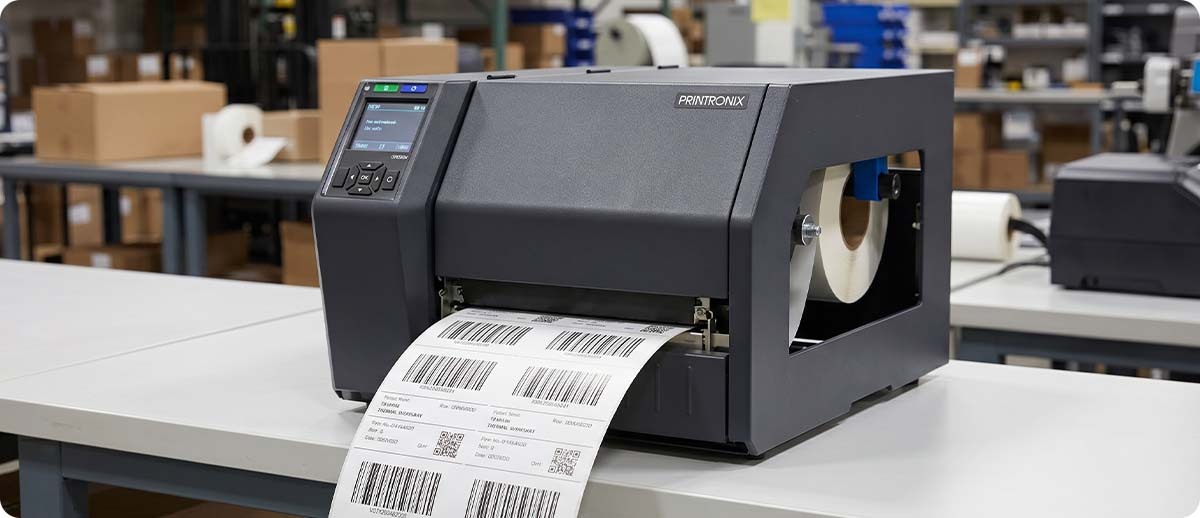
TSC Printronix is one of the few manufacturers that offers a current production 8-inch wide format industrial thermal printer in their standard lineup. The T8000 series has been their high-end industrial platform for years and is specifically positioned for the mission-critical, high-volume manufacturing and distribution applications that the 220Xi4 served.
The T8000 in the 8-inch configuration delivers a maximum print width of 8.5 inches, which actually exceeds the 220Xi4's 8-inch print width. It is available in both 203 DPI and 300 DPI configurations. It supports thermal transfer and direct thermal. It is built around a full metal enclosure with a die-cast aluminum frame and a dual motor ribbon drive system, which puts it in the same class of physical durability as the 220Xi4. It is rated for 24/7/365 continuous operation and carries extended and comprehensive warranty options for operations that need service coverage on a production-critical printer.
The T8000 also includes a feature set that the 220Xi4 generation did not offer: a color display with navigation keys, PostScript and PDF printing support, 512MB DRAM memory, connectivity via Ethernet, USB, and Serial as standard, optional Wi-Fi, ERP integration support for SAP and Oracle, and support for the ODV-2D inline barcode verifier option. The verifier option is particularly relevant for GHS chemical drum labeling and compliance labeling operations that need to verify barcode quality as labels are printed, not after they are applied to drums or pallets in the field.
In terms of print speed, the T8208 (8-inch, 203 DPI) runs at 10 inches per second and the T8308 (8-inch, 300 DPI) runs at 8 inches per second. For operations coming off the 220Xi4, these are competitive throughput numbers for wide-format industrial printing.
The ZPL Migration Question
The first concern most 220Xi4 operations raise when evaluating a non-Zebra replacement is the label language question. The 220Xi4 is a native ZPL printer. Label templates, print-triggering integrations with ERP and WMS systems, and the label design software configuration are all built around ZPL commands. Moving to a printer that does not speak ZPL requires reworking all of that, which is a real migration cost.
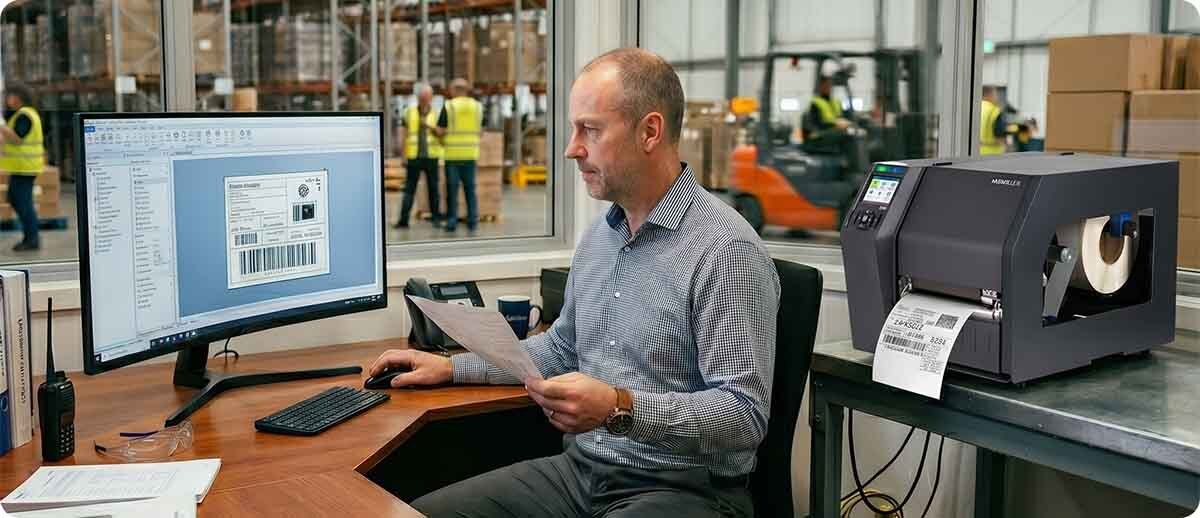
The T8000 addresses this directly. ZPL is one of the T8000's standard emulation languages. The full emulation list includes PGL, VGL, ZPL, TGL, IPL, STGL, and DPL. For operations whose label templates and integration workflows are built in ZPL, the T8000 accepts those ZPL commands without requiring label redesign or integration rework. This is not a conversion layer or a workaround. ZPL emulation on the T8000 is a production-supported standard feature of the platform.
In practice, operations migrating from the 220Xi4 to the T8000 should test their existing ZPL label templates on the T8000 before full deployment, because any ZPL migration benefits from a validation pass even when the receiving printer has robust ZPL emulation. Most label templates transfer cleanly. Complex templates with proprietary Zebra extensions or ZebraLink-specific features may require minor adjustments. Advanced Automation can run that validation as part of a migration engagement, which avoids the discovery of template issues after production deployment.
T8000 Configurations at Advanced Automation
The T8000 series covers four-inch, six-inch, and eight-inch print widths at both 203 and 300 DPI. For operations replacing the 220Xi4, the 8-inch models are the direct functional replacement. The 6-inch models are the right specification for operations that were using the 220Xi4 for wide-format applications that could actually be served by 6-inch wide media, which is worth evaluating before defaulting to the 8-inch configuration. The 4-inch models are also available for operations consolidating mixed fleets.
TSC Printronix T8208 — 8-Inch, 203 DPI Industrial Printer
Part #: T82X8-1106-0 | 8.5" max print width | 203 DPI | 10 ips | DT and TT | Serial, USB, Ethernet
The direct 203 DPI replacement for the 220Xi4 in the T8000 series. Exceeds the 220Xi4's 8-inch print width at 8.5 inches maximum. Full metal enclosure, die-cast aluminum frame, dual motor ribbon drive. ZPL emulation standard. 24/7/365 rated. For operations that currently run 203 DPI on the 220Xi4 and want a like-for-like resolution migration, this is the straightforward replacement configuration.
View T8208 →TSC Printronix T8308 — 8-Inch, 300 DPI Industrial Printer
Part #: T83X8-1200-0 | T83X8-1140-0 | T83X8-5113-1 (with verifier) | 8.5" max print width | 300 DPI | 8 ips
The 300 DPI 8-inch configuration for applications where higher print resolution matters across the full 8-inch width. GHS chemical drum labels with detailed hazard pictograms and fine text benefit from 300 DPI over 203 DPI at large label sizes. The T83X8-5113-1 adds the ODV-2D inline barcode verifier, which validates every barcode as it prints and flags failures before the label leaves the printer. For compliance labeling operations where barcode quality is a regulatory requirement, the verifier configuration eliminates the need for a separate offline verification step and provides an audit trail of verified label output.
View T8308 →TSC Printronix T8206 — 6-Inch, 203 DPI Industrial Printer
Part #: T82X6-1100-0 | 6.6" max print width | 203 DPI | 12 ips
For 220Xi4 operations whose actual label width requirements fall within 6.6 inches, the T8206 is the right replacement. The 6-inch configuration prints faster than the 8-inch (12 ips versus 10 ips at 203 DPI) and is a simpler specification for applications that do not genuinely need the full 8-inch width. Before defaulting to the T8208, it is worth confirming the maximum label width in active use. Many operations that deployed 220Xi4 printers for the wide-format capability have found that their actual label stock is 6 inches or narrower, making the T8206 the more cost-effective and operationally appropriate replacement.
View T8206 →TSC Printronix T8306 — 6-Inch, 300 DPI Industrial Printer
Part #: T83X6-1142-0 | T83X6-1100-3 | 6.6" max print width | 300 DPI | 10 ips
The 300 DPI 6-inch configuration for operations whose label width fits within 6.6 inches but whose print quality requirements favor 300 DPI. Useful for compliance labels with fine pictogram detail, dense 2D barcodes at mid-range label sizes, and applications where the step up in resolution is justified by the label content without needing the full 8-inch width.
View T8306 →220Xi4 vs. T8000: The Key Specification Comparison
| Specification | Zebra 220Xi4 (discontinued) | TSC T8208 / T8308 (current) |
|---|---|---|
| Max print width | 8.0 inches | 8.5 inches |
| DPI options | 203 DPI standard | 203 DPI (T8208) or 300 DPI (T8308) |
| Print speed (203 DPI) | Up to 12 ips | 10 ips (T8208) |
| Label language | Native ZPL | ZPL emulation + PGL, VGL, IPL, DPL, TGL, STGL |
| Print method | Thermal transfer and direct thermal | Thermal transfer and direct thermal |
| Connectivity | Serial, Parallel, USB, Ethernet | Serial, USB, Ethernet (standard) plus optional Wi-Fi |
| Display | Front panel with optional LCD | Color display with navigation keys (standard) |
| Inline barcode verifier | Not available | Optional ODV-2D inline verifier |
| Cold temperature operation | Standard range | -5°C / 23°F (DT) without heated enclosure |
| Manufacturer status | Discontinued, limited support remaining | Current production, full support |
| Service contract availability | Limited to remaining support window | 3-year and 5-year extended and comprehensive warranties |
Who Needs the 8-Inch Wide Format and Who Does Not
Not every 220Xi4 deployment actually needs 8-inch wide format capability in the replacement. Some operations installed the 220Xi4 for its industrial-grade build and reliability, using media that is actually narrower than the maximum 8-inch width. Before specifying the T8208 or T8308, the right question is: what is the widest label currently being printed on the 220Xi4?
If the answer is 6 inches or under, the T8206 or T8306 is the functionally equivalent replacement at a lower cost point. The 6-inch T8000 models print faster than the 8-inch models at equivalent DPI, and the specification is matched to the actual print requirement rather than to the maximum capability of the device being replaced.
If the answer is over 6 inches, the T8208 or T8308 is required. The specific applications that drive genuine 8-inch wide format requirements include GHS chemical drum labels at 8-inch width (a common OSHA and GHS compliance format for 55-gallon drum labeling), wide-format shipping documentation, full-face pallet labels covering the full face of a 48-inch pallet where a large label surface is required, and wide-format barcode labels for large equipment or asset identification where the barcode must be scannable from a distance and therefore printed at a larger size.

Frequently Asked Questions: 220Xi4 to T8000 Migration
We are still getting parts for our 220Xi4. How urgent is the transition?
Parts availability for discontinued hardware diminishes over time as existing inventory sells through. The urgency depends on how old your 220Xi4 units are and how close they are to the end of their useful service life. Operations with relatively young 220Xi4 fleets may have more runway. Operations with aging units approaching five or more years of service in high-volume environments should treat the transition planning as immediate. The right time to plan a migration is before a hardware failure forces an emergency replacement, not after. Factoring in the time required for ZPL template validation, T8000 deployment, and staff training, a properly planned transition takes more lead time than most operations expect.
Will our existing label templates work on the T8000 without redesign?
For most operations, yes. The T8000 supports ZPL emulation as a standard feature, so ZPL-based templates and integrations should transfer without requiring a complete redesign. The correct approach before production deployment is to run your existing templates on a T8000 test unit and validate the output against your quality standard. Most templates transfer cleanly. Templates that use Zebra-proprietary extensions or ZebraLink-specific features may need minor adjustments. Advanced Automation can support the validation process as part of a migration engagement to identify any issues before they affect production.
Is the ODV-2D inline verifier worth the additional cost for our GHS chemical labeling operation?
For GHS chemical drum labeling specifically, the inline verifier deserves serious evaluation. GHS compliance labels on hazardous chemical containers must be readable throughout the product's lifecycle. A label with a barcode that fails to scan in the field creates a compliance problem and a safety problem simultaneously. The ODV-2D verifier grades every barcode as it prints and stops the printer if a label falls below the specified quality grade. The verifier also creates an audit log of verified output, which supports compliance documentation requirements. For operations that currently perform offline barcode verification as a separate quality step, the inline verifier eliminates that step and provides continuous verification rather than sampled verification.
Can the T8000 integrate with our SAP or Oracle ERP system the same way the 220Xi4 did?
Yes. TSC Printronix documents SAP and Oracle ERP integration support for the T8000 series. The T8000's ZPL emulation and multiple connectivity options, including Ethernet, make it compatible with the same middleware and print management architectures used with the 220Xi4. If your current 220Xi4 integration uses Loftware or another label management platform with an SAP or Oracle connector, those platforms support the T8000 as a target printer. Advanced Automation is an authorized Loftware partner and can support the integration validation as part of a T8000 deployment project.
If you are running 220Xi4 printers today and need to understand your replacement timeline, or if you are evaluating a new wide-format printing deployment and working out which T8000 configuration fits your requirements, our team has been through this transition with operations in chemical manufacturing, distribution, and industrial labeling environments. Fill out the form below and let's map out the right path forward for your specific situation.