
GS1 Sunrise 2027: What the 2D Barcode Transition Actually Means for Your Operation
Posted by Advanced Automation on Apr 27th 2026

By Advanced Automation, Inc. | Barcode Standards | GS1 Sunrise 2027 Readiness Guide
GS1 Sunrise 2027 is the most significant change to barcode standards since the UPC was invented in 1974. That's not hyperbole, it's the assessment of the standards body that governs global product identification. For 50 years, the 1D barcode has done one job: encoding a 12-digit GTIN for price lookup at checkout. Sunrise 2027 replaces that single-purpose symbol with a 2D code capable of carrying the GTIN plus lot number, expiration date, serial number, and a GS1 Digital Link URI, a structured web address that connects the physical product to real-time supply chain data and consumer-facing information simultaneously.
The initiative is industry-led, not a government mandate, no federal agency will issue a fine on January 1, 2028 for a product still carrying only a 1D UPC. But the practical compliance pressure comes from the retail partners who drive purchasing decisions. Walmart, Target, and other major US retailers are building 2D scanning capability into their POS infrastructure on or ahead of the 2027 timeline, and supplier labeling requirements follow retailer readiness. If your products appear on the shelves of major retailers in 2027 and beyond, 2D barcode readiness isn't optional.
This blog covers the four parts of the operation that Sunrise 2027 actually touches: the barcode format itself, the scanner hardware that needs to read it, the printer and label system that needs to produce it, and the software layer that needs to manage GS1 Digital Link data. Operations that treat this as a packaging design question alone will find themselves with a compliance gap they didn't see coming.
What GS1 Sunrise 2027 Actually Requires
The core requirement is specific: by December 31, 2027, retail point-of-sale systems must be capable of reading and processing a GTIN contained in a 2D barcode, specifically a QR Code encoded with a GS1 Digital Link URI or a GS1 DataMatrix code. The 1D UPC is not being banned. The transition period calls for dual-marking — products carry both the existing 1D barcode and a 2D code simultaneously, which ensures compatibility during the years when not all POS systems are upgraded. From 2028 onward, manufacturers may choose to use only 2D codes, but this remains optional.
The two approved 2D formats are:
QR Code with GS1 Digital Link URI. A standard consumer QR code typically encodes a simple URL. A GS1 Digital Link QR code follows a specific URI syntax that embeds the product's GTIN and optionally its lot number, expiration date, serial number, and other GS1 Application Identifiers. The URI structure, allows the same code to be processed at POS as a product identifier and scanned by a consumer's smartphone to access ingredient lists, traceability information, or sustainability data. One code does both jobs. This is the format most often seen on consumer packaged goods.
GS1 DataMatrix. A square 2D matrix code widely used in pharmaceutical, healthcare, and small-item applications where a compact footprint is required and consumer smartphone scanning is not the primary use case. GS1 DataMatrix encodes the GTIN plus Application Identifiers in a format that is both machine-readable at high speed and readable at very small print sizes — a critical capability for unit-dose pharmaceutical packaging and electronic component labeling.
The data capacity difference between 1D and 2D is significant. A UPC/EAN barcode stores 12 characters, the GTIN and nothing else. A 2D barcode stores up to 7,000 numeric characters. That additional capacity is the entire value proposition of Sunrise 2027: expiration date management, batch-level traceability, serialization for anti-counterfeiting, and real-time recall capability all become possible when the barcode carries more than a product number.
The Four Places Your Operation Needs to Be Ready
1. Your POS and Scanning Infrastructure
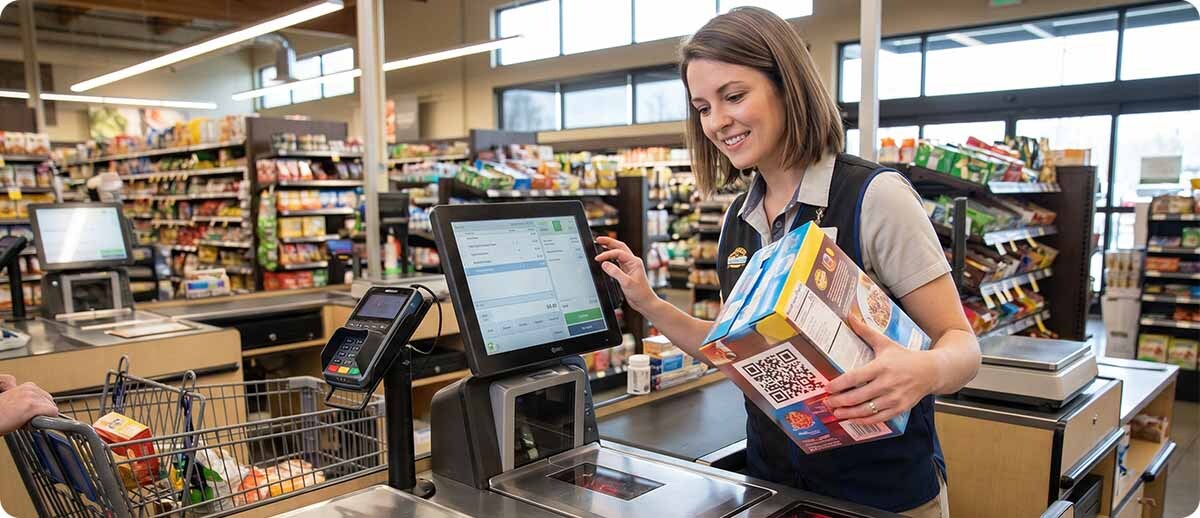
This is the primary readiness requirement GS1 places on retailers: POS scanners must be able to read and correctly process a 2D barcode by end of 2027. For operations on the retail side of the supply chain — grocery, CPG, general merchandise, pharmacy, this means evaluating every scanner at every checkout lane and determining whether it is 2D-capable and correctly configured to extract the GTIN from a GS1 Digital Link URI.
This is where a critical distinction appears: reading a 2D barcode and correctly processing a GS1 Digital Link URI are not the same thing. Many older 2D-capable scanners can image and decode a QR code, but they return the full URI string to the POS system rather than parsing the GTIN out of the Digital Link structure. The POS system then receives a URL instead of a product number, which it can't process as a price lookup. A scanner that is GS1 Digital Link-ready not only reads the 2D code but parses the URI to extract the GTIN and any additional GS1 Application Identifier data and passes them to the POS system in the same format it currently receives from a 1D scan.
The Zebra DS9308 presentation scanner, available on the AA site, is one example of a scanner available in a GS1 Digital Link-parsing configuration (DS9308-DL00004ZZNA). The DL variant is specifically configured to parse GS1 Digital Link URIs and output correctly structured data to the POS system. For operations evaluating POS scanner readiness, the distinction between a 2D-capable scanner and a Digital Link-parsing scanner is the gap that most commonly gets missed in a readiness assessment.
For high-volume retail environments with cashier-manned and self-checkout lanes, the Zebra MP7000 multi-plane scanner provides 1D/2D imaging in a fixed presentation format designed to drop into existing POS fixture cutouts. The MP7000's multi-plane imaging captures barcodes from any orientation at the speeds required for high-volume checkout, and it reads both the existing 1D UPC and the new 2D codes during the dual-marking transition period, so no checkout disruption occurs as packaging gradually shifts to include 2D codes.
Zebra DS9308 — Compact Presentation Scanner with 2D Imager
Part #: DS9308-SR4U2100AZW (USB kit) | DS9308-SR00004ZZWW (scanner only) | DS9308-DL00004ZZNA (GS1 Digital Link parsing)
The DS9308 is Zebra's compact counter-top presentation scanner — small enough for tight POS real estate while delivering enterprise-grade 1D and 2D imaging performance. The DS9308-DL configuration adds GS1 Digital Link parsing, extracting the GTIN and Application Identifier data from a Digital Link QR code and passing it to the POS system in a format the system already understands. For retail operations evaluating Sunrise 2027 readiness at individual lanes, the DS9308-DL is the targeted solution.
View Zebra DS9308 →Zebra MP7000 — Multi-Plane POS Scanner (1D/2D Imager)
Part #: MP7001-MNSLM00US | MP7001-MPSLM00US | MP7011-MNSLM00US | multiple configurations
The MP7000 is Zebra's highest-performance fixed multi-plane POS scanner — designed for the highest-volume cashier and self-checkout lanes. Multi-plane 1D/2D imaging captures barcodes from any orientation at checkout-line speeds. Three available sizes fit existing POS fixture cutouts for drop-in installation. For retailers upgrading checkout infrastructure to handle 2D codes at POS, the MP7000 delivers the throughput and omnidirectional imaging required at the busiest lanes.
View Zebra MP7000 →2. Your Label Printing Infrastructure
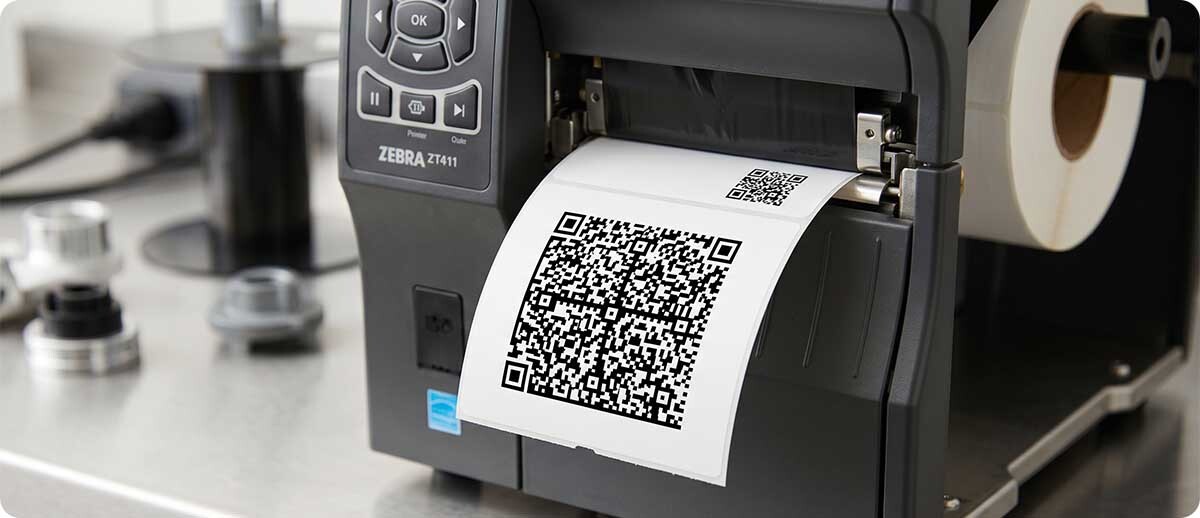
Printing a 2D barcode reliably is not the same as printing a 1D barcode. The data density of a QR code or GS1 DataMatrix code, particularly at the smaller print sizes found on unit-dose pharmaceutical labels, food item labels, or shelf-edge labels, requires higher print resolution and more precise dot placement than a 1D barcode at the same size.
A 1D UPC barcode on a 4x6 shipping label printed at 203 DPI scans reliably because the individual bars are wide enough to be cleanly defined at that dot density. A GS1 DataMatrix code at the same label size has module elements that may be as small as 0.3-0.5mm, and at 203 DPI (0.125mm dot size), those modules are defined by only 2-4 dots each. Dot gain, printhead wear, and media variability all affect edge definition at these scales. Operations that will be printing high-density 2D codes at small sizes need to evaluate whether their current printer DPI, printhead condition, and media combination reliably produce codes that pass ISO/IEC 15415 print quality verification standards, the same standards GS1 references in its Sunrise 2027 solution provider guidance.
For most standard shipping and receiving label applications at 4x2 or larger, a 300 DPI thermal transfer printer produces reliable QR and Data Matrix codes with adequate module definition. For smaller label formats, unit-dose pharmaceutical labels, cosmetics packaging, apparel hang tags, 300 DPI is marginal and 600 DPI is the appropriate specification. The Zebra ZT411 in 300 DPI thermal transfer configuration handles the majority of GS1 Sunrise label applications. Operations printing 2D codes at very small sizes on pharmaceutical or cosmetics packaging should evaluate 600 DPI configurations.
There is also a ribbon consideration. Thermal transfer printing at 300 DPI requires a ribbon matched to the facestock for clean dot definition and minimal bleeding. Direct thermal media cannot produce the edge definition required for high-density 2D codes at small sizes and should not be specified for Sunrise 2027 labeling on small formats. For operations currently printing with wax ribbons on coated paper at low print speeds, a ribbon upgrade to wax-resin or resin, matched to the 2D code density and label size, is part of the print quality evaluation.
Zebra ZT411 Industrial Thermal Transfer Printer
Part #: ZT41142-T010000Z (203 DPI) | ZT41143-T010000Z (300 DPI) | multiple configurations
The ZT411 is Zebra's mid-range industrial printer — all-metal construction, 24/7 duty cycle, available in 203 and 300 DPI (and 600 DPI for precision micro-label applications). The 300 DPI configuration handles the majority of GS1 Sunrise 2027 labeling requirements: QR codes and GS1 DataMatrix at standard label sizes for shipping, receiving, food and beverage, and general merchandise applications. Link-OS for centralized configuration and Loftware integration. For operations that need to generate GS1-compliant 2D codes from WMS or ERP data triggers, the ZT411 is the industrial printing backbone of a Sunrise-ready label system.
View Zebra ZT411 →Zebra ZD621 Desktop Thermal Transfer Printer
Part #: ZD6A043-301F00EZ (300 DPI, wired) | ZD6A042-D01F00EZ (203 DPI, direct thermal) | multiple configurations
The ZD621 is Zebra's premium desktop printer — 4-inch print width, 300 DPI thermal transfer, Link-OS, color touch display, and wireless options for back-office, retail, and mid-volume applications. For operations adding 2D barcode printing capability at a department or workstation level rather than a production line, the ZD621 300 DPI thermal transfer configuration supports GS1 DataMatrix and QR code printing at standard label sizes. Fully compatible with Loftware label software for WMS-triggered label generation.
View Zebra ZD621 →3. Your Label Design and Data Management Software
This is where most operations discover the most significant gap, and it's the one that takes the most time to close. Generating a GS1 Digital Link QR code is not the same as generating a standard QR code that links to a URL. The URI must be structured according to the GS1 Digital Link standard (ISO/IEC 18975): the GTIN must be in the correct position, Application Identifiers must be formatted correctly, and any dynamic data, lot number, expiration date, serial number — must be drawn from the correct authoritative source at print time.
If a worker manually types a lot number into a label template to generate a QR code, the code will be structurally incorrect or will carry wrong data the moment the worker makes a transcription error. The only reliable path to GS1-compliant 2D label output is a label management system that generates the GS1 Digital Link URI dynamically from authoritative data sources, ERP, WMS, or MES, at the time of printing, with no manual data entry in the loop.
Loftware, which Advanced Automation is an authorized partner for, is one of the few label management platforms with certified GS1 Digital Link support and pre-built integrations to SAP (certified for SAP ECC and S/4HANA), Oracle (pre-built connectors for Oracle E-Business Suite and Oracle Cloud), and Microsoft Dynamics (real-time integration for Dynamics 365 and NAV). When a receiving transaction completes in SAP, Loftware generates the GS1-compliant 2D label from the authoritative ERP data and routes it to the correct printer automatically. The lot number, expiration date, and GTIN are pulled from the system of record, not typed by a worker. This is what a Sunrise-ready label workflow actually looks like.
Operations running existing label software that generates only standard QR codes without GS1 Digital Link URI structure need to evaluate whether that software can be configured or upgraded to produce compliant output — or whether a platform migration is required. This evaluation should be happening now, not in late 2027, because ERP integration and label template migration timelines are measured in months, not weeks.
4. Your Supply Chain Scanning Infrastructure (Beyond POS)
Sunrise 2027's headline requirement is POS readiness, but the supply chain opportunity extends well beyond checkout. The same 2D code that carries expiration date and lot number at POS can be scanned at receiving to automatically capture lot and expiry without manual entry. It can be scanned at the pick face to validate that the correct batch is being selected. It can be scanned at outbound to trigger automated recall-risk screening against lot numbers in a product alert database.
This supply chain data capture is only possible if the mobile computers and fixed scanners used throughout the warehouse are 2D-capable and configured to parse GS1 Application Identifier data, lot, expiry, serial, from 2D barcodes and pass it correctly to the WMS. Most current-generation Zebra and Honeywell mobile computers and handheld scanners are 2D-capable at the hardware level. The configuration question is whether the scan engine symbology settings and the WMS input parsing are set up to handle the additional GS1 Application Identifier fields that a 2D code carries, rather than treating the entire encoded string as a single GTIN.
This is a configuration and middleware task more than a hardware replacement task for operations already running current-generation devices. But it requires deliberate testing across the receiving, picking, and shipping workflows to confirm that GS1 2D data is flowing correctly into the WMS and being stored and acted upon correctly, not silently dropped or passed as an unparsed string.
The Readiness Timeline: Where You Need to Be and When
| Timeframe | What Needs to Happen | Who It Affects |
|---|---|---|
| Now — Mid 2026 | Audit scanner hardware at POS for 2D capability and GS1 Digital Link parsing. Audit label software for GS1 Digital Link URI generation capability. Identify ERP/WMS integration gaps for lot, expiry, and serial data. | Retailers, brands, CPG manufacturers, food & beverage, pharma |
| Mid 2026 — Early 2027 | Upgrade or replace non-compliant POS scanners. Implement or configure label management software for GS1 Digital Link output. Begin dual-marking on packaging — add 2D code alongside existing 1D barcode. Test 2D data flow through supply chain systems. | All parties in retail supply chain |
| Mid — End 2027 | POS systems reading and processing 2D codes across all lanes. Dual-marked packaging in broad production. Validate 2D scan performance at POS and throughout supply chain with GS1 test kit. | Retailers (primary deadline); brands and suppliers (packaging) |
| 2028 and Beyond | Manufacturers may begin single-carrier 2D-only packaging (optional). Supply chain workflows begin fully leveraging lot/expiry/serial data from 2D codes for receiving, traceability, and recall management. | Brands and manufacturers at their discretion |

Frequently Asked Questions: GS1 Sunrise 2027
Is Sunrise 2027 a legal requirement? What happens if we don't comply?
Sunrise 2027 is not a government law or regulatory mandate, no federal or state agency will issue a fine for non-compliance. The compliance pressure comes from retail trading partners. If your key retail customers have implemented Sunrise 2027 requirements in their supplier labeling specifications, non-compliance may affect your ability to sell through those channels. Several major US retailers have already communicated requirements to specific supplier categories ahead of the 2027 target. The practical answer is to check the labeling specifications of your key retail partners directly — retailer-specific requirements may be more stringent than the GS1 baseline.
We already print QR codes on our packaging. Are we Sunrise 2027 compliant?
Not necessarily. A standard QR code that links to a product landing page or marketing URL is not GS1-compliant for Sunrise 2027. Compliance requires the QR code to encode a GS1 Digital Link URI in the correct format, including the GTIN in the correct position within the URI structure — so that it can be parsed by a Sunrise-ready POS scanner to extract the GTIN for price lookup. If your QR code doesn't encode a GS1 Digital Link URI with your product's GTIN, it will not process correctly at POS and will not satisfy Sunrise 2027 requirements. Your label software or GS1 Digital Link configuration needs to generate the correct URI format.
Will we need to replace all our existing barcode scanners in the warehouse?
Most current-generation enterprise mobile computers and handheld scanners from Zebra and Honeywell, devices from the last 5-7 years with 2D imager engines (SE4750, SE4850, SE4770, and newer) are fully capable of reading GS1 DataMatrix and GS1 Digital Link QR codes at the hardware level. The more important question is whether your scanner symbology and Application Identifier parsing is configured correctly, and whether your WMS is set up to receive and process the additional data fields (lot, expiry, serial) that a 2D code carries. Hardware replacement is likely only needed for older devices still running 1D-only laser scan engines or very early 2D imager engines.
We're a 3PL — does Sunrise 2027 affect us even though we don't put product on retail shelves?
Yes, potentially significantly. If you're receiving product from brand customers that are dual-marking with 2D codes during the transition, your receiving systems need to handle both 1D and 2D codes without errors. More importantly, if your brand customers begin using the lot number, expiration date, and serial number data in the 2D code as part of their inventory management and traceability workflow, your WMS needs to capture that data correctly at receiving and maintain it through pick and ship. A 3PL that receives a dual-marked product and only captures the 1D GTIN while discarding the lot and expiry data in the 2D code is not delivering the traceability service the brand customer will increasingly require.
How long does a Sunrise 2027 readiness project typically take?
It depends on how many of the four areas need changes. POS scanner hardware upgrades at a single location can be completed in days to weeks. Label software configuration for GS1 Digital Link URI output, particularly when ERP integration is involved — typically takes two to four months for a well-scoped project. Packaging design changes for dual-marking require design lead time plus print vendor lead time and are typically a three to six month cycle. For operations that need to address all four areas simultaneously, starting now, mid 2026, leaves adequate runway before the end of 2027 deadline, but there is no more time to defer the assessment.
GS1 Sunrise 2027 touches more of the operation than most teams initially expect, and the lead times on software integration, packaging redesign, and scanner configuration are longer than the deadline makes them appear. If you're working through your readiness assessment and want a second set of eyes on the hardware and software gaps, our team has been working through this evaluation with operations across manufacturing, distribution, retail, and food and beverage. Fill out the form below and let's map out where your operation stands.