
Is RFID Finally Ready for Mid-Sized Manufacturing?
Posted by Advanced Automation on Apr 6th 2026
By Advanced Automation | Manufacturing Technology | RFID Implementation Guide
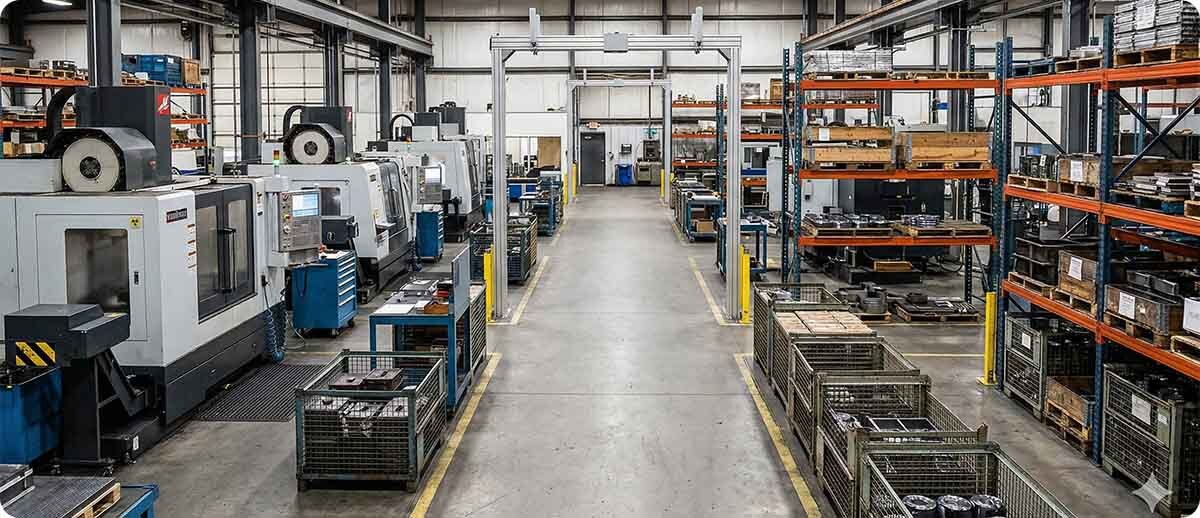
Radio frequency identification has been "almost ready" for mainstream manufacturing adoption for the better part of two decades. The technology itself works — has worked reliably for years in large-scale retail distribution, aerospace, and pharmaceutical environments. The question was never whether RFID could deliver on its promise of automated, hands-free inventory visibility. The question was whether the economics made sense for operations running 50 to 500 employees, managing moderate asset complexity, without the IT infrastructure or capital budget of a Fortune 500 operation.
The answer, increasingly, is yes — with important qualifications. Hardware costs have dropped significantly. RAIN UHF RFID (the passive UHF standard now dominant in industrial applications) has matured into a stable, interoperable ecosystem. Zebra Technologies and other major manufacturers have built RFID-capable products that integrate with the barcode infrastructure most mid-sized manufacturers already run. And the use cases that actually deliver fast, measurable ROI in a mid-size shop floor have become much clearer.
But "ready" doesn't mean "simple." Metal-heavy manufacturing environments still challenge RF propagation. WMS and ERP integration requires planning. And the most common mistake mid-sized operations make is deploying RFID everywhere when a targeted, phased approach delivers faster returns with less risk.
This guide addresses all of it: what's genuinely changed about RFID economics, where the technology performs well in mid-sized manufacturing, where it still struggles, and which specific Zebra hardware from Advanced Automation is the right starting point for each layer of an RFID deployment.
What Has Actually Changed About RFID Economics
The narrative that RFID is "finally affordable" has been circulating for years, so it deserves a specific, honest accounting of what has actually shifted versus what is still a meaningful cost consideration.
What Has Genuinely Gotten Cheaper
Passive UHF RFID tags. The cost of a passive RFID inlay — the antenna and chip embedded in a label — has fallen from roughly $0.25–$0.50 per tag a decade ago to under $0.10 for high-volume purchases of standard inlays in 2026. For many manufacturing applications where tags are applied to durable assets (WIP containers, tooling, fixtures, pallets), the per-tag cost is largely irrelevant compared to the labor it replaces. Even for item-level tagging of moderate-value components, the economics have shifted meaningfully.
Fixed reader infrastructure. The Zebra FX7500, for example, is a capable 2- or 4-port fixed RFID reader with PoE connectivity that represents a fraction of the cost of first-generation fixed readers. A single FX7500 with two antennas can cover a dock door or a WIP staging area at a price point that was unattainable for mid-sized operations five years ago.
RFID-capable mobile computers. Devices like the Zebra MC3300 RFID series read both RFID tags and barcodes in a single unit. A mid-sized manufacturer doesn't need separate device fleets for barcode scanning and RFID reading — the same device handles both, and workers interact with it exactly as they do with a standard mobile computer. The marginal cost of RFID capability on top of a mobile computer the operation would buy anyway has become modest.
Retrofit options for existing printer fleets. Zebra's ZT400 Series RFID Upgrade Kit allows operations already running ZT410 or ZT420 barcode printers to add RFID encoding capability without replacing the entire printer. This is a particularly meaningful development for mid-sized manufacturers who have already invested in Zebra industrial printers — the path to RFID-capable label printing doesn't require a full hardware refresh.
What Still Requires Significant Investment
Integration with existing ERP and MES systems. The hardware is more accessible. The software integration is not. Connecting RFID read events to your ERP's inventory module, work order system, or production tracking application requires middleware or custom development that varies enormously by platform. This is where mid-sized manufacturers most commonly underestimate total project cost.
Site surveys and RF planning. A manufacturing floor with heavy metal equipment, welding operations, liquids, and dense racking presents real RF challenges that require expert antenna placement and reader configuration. Deploying RFID without a proper site survey leads to read rate problems that undermine confidence in the system — and these problems are often attributed to the technology when they're actually installation issues.
Specialized tags for metal surfaces and harsh environments. Standard paper RFID labels detune significantly when applied directly to metal surfaces. Operations tracking metal assets — machine tools, fixtures, metal WIP containers — require on-metal RFID tags, which cost considerably more than standard inlays. This is a real cost driver in metal-heavy manufacturing that the general "RFID is cheap now" narrative often understates.

Where RFID Delivers Fast ROI in Mid-Sized Manufacturing
Not all RFID use cases are created equal, and mid-sized manufacturers who deploy RFID everywhere simultaneously often end up with a complex, underperforming system and skeptical workers. The operations that consistently see fast, measurable returns from RFID focus on a small number of high-impact use cases first.
1. WIP Container and Pallet Tracking
Work-in-process inventory frequently disappears into manufacturing operations and requires manual searching, phone calls, and floor walks to locate. A fixed RFID reader at each zone transition point — receiving, fabrication entry, assembly staging, finishing, shipping — automatically records when a tagged container moves between zones. The result is real-time WIP visibility without any worker action: no scanning, no paperwork, no radio calls.
This is one of the most consistently high-ROI RFID use cases in manufacturing because the current process is almost entirely manual and labor-intensive. A mid-sized manufacturer running 200 WIP containers across a facility can realistically eliminate dozens of hours per week of inventory hunting with a relatively modest fixed reader installation.
2. Tooling and Fixture Management
Tooling management is a chronic pain point in precision manufacturing. Tools go missing, are used past their service interval, or are found in the wrong location at critical production moments. RFID-tagged tooling tracked through a tool crib or calibration station automates check-out/check-in, enforces service interval compliance, and provides location history that manual systems simply cannot match.
This application requires on-metal capable tags for direct attachment to metal tool bodies — a cost consideration, but one that pays back quickly when you account for the cost of a single lost or out-of-calibration tool creating a production hold or quality escape.
3. Receiving and Dock Door Automation
A fixed RFID reader at a dock door reads every tagged case or pallet that passes through simultaneously — without a worker scanning each item individually. For operations receiving from suppliers who already apply GS1-compliant RFID labels (increasingly common as major retailers push supplier RFID mandates down the supply chain), dock door RFID delivers immediate receiving automation with no per-item labor.
Even for inbound goods that don't arrive pre-tagged, a dock door reader paired with an RFID-capable printer at receiving applies and reads tags in a single workflow step, creating a clean electronic receiving record that feeds directly to inventory without manual data entry.
4. Finished Goods and Shipping Verification
Shipping errors — wrong item, wrong quantity, missing item — are among the most expensive mistakes a manufacturer can make in terms of customer relationship damage, return freight, and re-fulfillment labor. A shipping lane RFID portal that reads every tagged item in an outbound shipment and compares it against the packing list catches errors before the truck leaves the dock. This application has an unusually clear and fast ROI: the cost of the RFID installation versus the cost of a handful of shipping errors it would prevent.
5. Cycle Counting
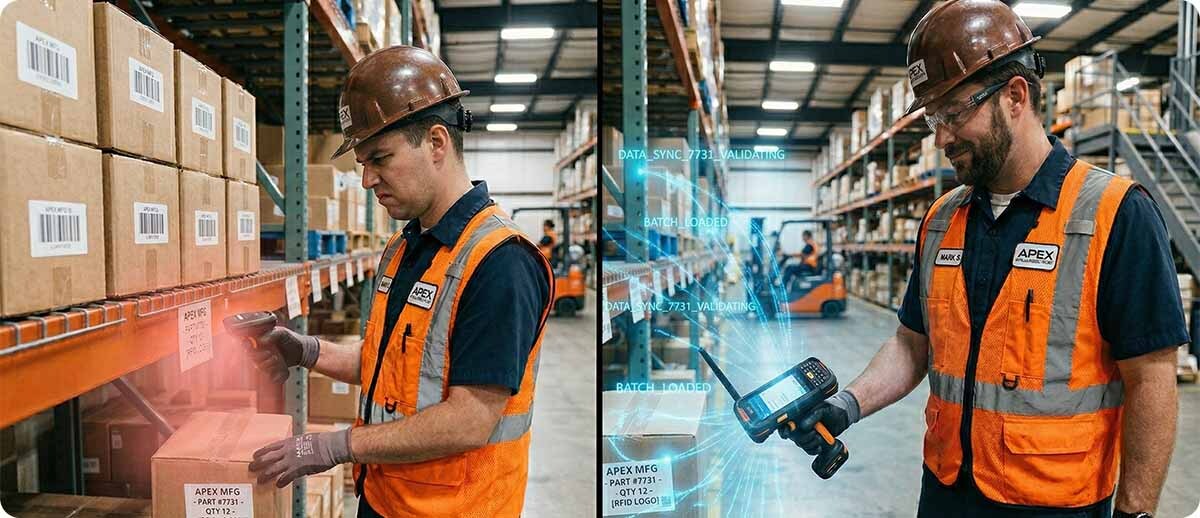
Traditional barcode-based cycle counting is slow: a worker walks to each item or bin location, scans one barcode at a time, records the count. RFID-based cycle counting with a handheld RFID reader allows a worker to walk an aisle and capture every tagged item in the field of view simultaneously — reading dozens of tags per second without line-of-sight or individual scans. Operations that previously required overnight shutdowns or dedicated cycle count teams can perform rolling cycle counts during normal production hours with a fraction of the labor.
Where RFID Still Struggles in Manufacturing Environments
Honest RFID guidance for manufacturing has to include this section. The technology has matured significantly, but it is not universally deployable, and environments that present specific RF challenges require careful planning or different approaches.
Metal-Dense Environments
Metal reflects UHF radio waves. In a facility with dense metal racking, metal machinery, and metal WIP, RF signal paths become complex and multipath interference reduces read reliability. This doesn't make RFID impossible in metal-dense environments — it makes antenna placement, reader sensitivity configuration, and tag selection more critical. The Zebra FX9600's exceptional RF sensitivity (-86 dBm) and the availability of on-metal RFID tags from Zebra address this, but they do require expert deployment. A site survey before purchasing hardware is not optional in a metal-heavy facility.
Liquid-Heavy Processes
Water and water-based liquids absorb UHF radio energy. Applications that involve tagging liquid-filled containers — coolant tanks, fluid reservoirs, aqueous cleaning operations — see significant read range degradation with standard RFID tags. Specialized tags designed for near-liquid or on-liquid applications exist but are more expensive and require matching reader configuration.
Very High Density, Mixed-Item Environments
Reading hundreds of tags simultaneously in a dense, mixed-orientation pile — think a bin full of mixed small parts — is significantly harder than reading tags on organized shelves or containers moving through a portal. The anti-collision algorithms in modern RFID readers handle multi-tag reads very well in structured environments, but accuracy drops when tags are stacked directly on each other or oriented randomly in close proximity.
Legacy ERP Systems Without RFID Middleware
An RFID read event is a data point — it only has value if it flows into a system that can act on it. Operations running older ERP or manufacturing execution systems that lack native RFID integration require middleware to translate RFID events into system transactions. This is a real project with real cost, and mid-sized manufacturers without internal IT resources should budget for it explicitly. The hardware is the simpler part of a full RFID deployment.
The Zebra RFID Hardware Stack for Mid-Sized Manufacturing
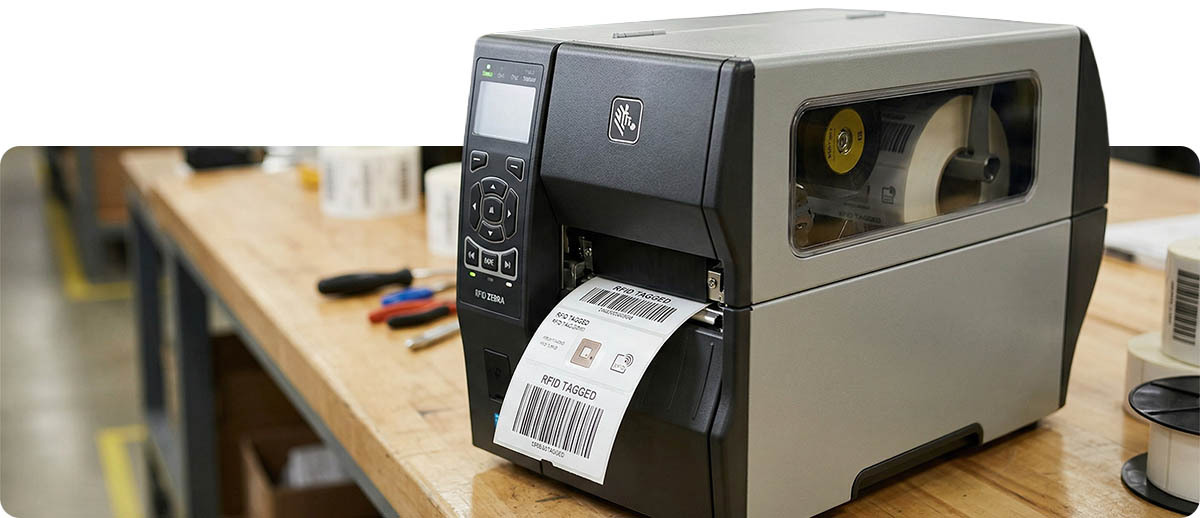
Advanced Automation carries the full Zebra RFID hardware portfolio across all three layers of a manufacturing RFID deployment: label printing and encoding, fixed infrastructure reading, and mobile handheld reading. Here is how each layer maps to the use cases above.
Layer 1 — RFID Label Printing and Encoding
Every RFID deployment begins with a tagged item. The Zebra ZT411 and ZT421 RFID industrial printers print and encode RFID labels in a single pass — the label prints with human-readable text and barcode while the embedded RFID inlay is simultaneously encoded with the correct EPC data. No separate encoding step, no risk of encoding-print mismatch.
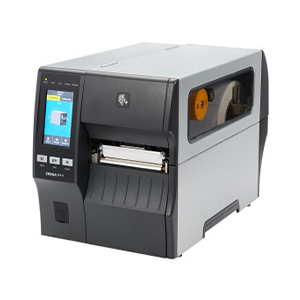
Zebra ZT411 RFID Industrial Printer
Part #: ZT41142-T0100A0Z
4-inch industrial RFID thermal transfer printer with UHF encoding in a single pass. RAIN RFID compliant. The ZT411 is also the only dedicated option for printing and encoding on-metal RFID tags — critical for manufacturing operations tracking metal assets. Zebra Print DNA (Link-OS) for remote management and integration. Adaptive encoding technology handles a wide range of RFID inlay types without manual calibration for each media change. Ideal for receiving dock labeling, WIP container tagging, and tooling management applications.
Shop the ZT411 RFID →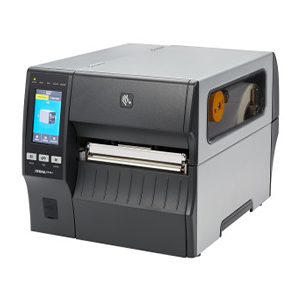
Zebra ZT421 RFID Industrial Printer
Part #: ZT42162-T0100A0Z
6-inch wide-format industrial RFID printer for larger case, pallet, and container labels. Prints and encodes at up to 14 inches per second. 4.3-inch full-color touchscreen for at-a-glance status. Adaptive encoding technology with excellent media flexibility for mixed RFID inlay deployments. All-metal frame and bi-fold door for demanding production environments. Right choice when label width exceeds 4 inches or throughput requirements demand maximum print speed.
Shop the ZT421 RFID →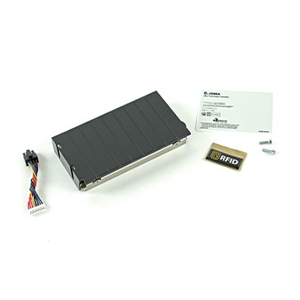
Zebra ZT400 Series RFID Upgrade Kit
Part #: P1058930-500A
Field-installable RFID upgrade kit for existing Zebra ZT410 and ZT420 industrial printers. Adds full UHF RFID encoding capability to barcode-only printer units already deployed in your facility — without replacing the printer. The most cost-effective path to RFID-capable printing for operations with an existing Zebra industrial printer investment. Contact Advanced Automation to confirm compatibility with your specific printer configuration before ordering.
Shop the ZT400 RFID Upgrade Kit →Layer 2 — Fixed Infrastructure Readers
Fixed readers are the backbone of zone-based RFID tracking — dock door portals, WIP zone transitions, finished goods staging, tool crib entry points. Zebra's FX7500 and FX9600 represent two distinct tiers of fixed reader capability, both confirmed in stock at Advanced Automation.
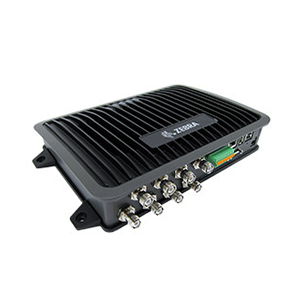
Zebra FX7500 Fixed RFID Reader (2-Port and 4-Port)
Part #: FX7500-42320A56-US (4-port) | FX7500-22320A56-US (2-port)
Compact, cost-efficient fixed RFID reader for indoor manufacturing and light industrial environments. Available in 2-port and 4-port antenna configurations. Integrated PoE for simplified installation without dedicated power runs. Linux-based architecture with support for LLRP, EPC standards, and auto-discovery. Excellent reader sensitivity with good interference rejection — well-suited for controlled indoor environments such as tool cribs, assembly staging areas, and internal zone transitions where RF environment is manageable. The right entry point for a first fixed reader deployment.
Shop the FX7500 (4-Port) →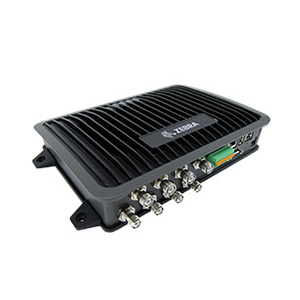
Zebra FX9600 Fixed RFID Reader (4-Port and 8-Port)
Part #: FX9600-42320A56-US (4-port) | FX9600-82320A56-US (8-port)
Industrial-grade fixed RFID reader delivering industry-leading read rates of up to 1,200 tags per second with exceptional RF sensitivity (-86 dBm) for reliable performance in dense RF environments with challenging materials including metal and liquids. IP53 sealed for dust and water resistance. PoE and PoE+ support. Available in 4-port and 8-port configurations — the 8-port model allows a single reader to cover multiple dock doors or portals, significantly reducing infrastructure cost per read point. Best-in-class processor with edge computing capability processes data locally before transmission to reduce backend server load. The right choice for dock door portals, busy WIP zone transitions, and any high-throughput or challenging RF environment.
Shop the FX9600 (4-Port) →Layer 3 — Mobile Handheld RFID Reading
Not every inventory touchpoint justifies a fixed reader installation. Cycle counting, audit workflows, locating specific assets in a large facility, and verifying specific items in a staging area all benefit from a worker-carried RFID reader that they can point at a zone or shelf section and read all tags simultaneously. The Zebra MC3300 RFID family is the leading platform for this application in industrial environments.
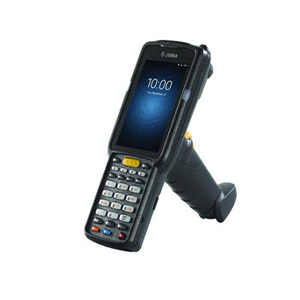
Zebra MC3300 RFID Mobile Computer (Standard Range)
Part #: MC333U-GJ2EG4US (MC333XR — standard range)
Rugged Android handheld that reads both UHF RFID tags and 1D/2D barcodes in a single device. Circular antenna for standard-range RFID reading — right for cycle counting in organized shelf and bin environments, tool crib audits, and receiving verification applications where items are within a few feet of the reader. 4GB RAM / 32GB ROM. Zebra Mobility DNA for enterprise management and DataWedge for seamless integration with manufacturing applications. One of the lightest devices in its class for all-day worker comfort.
Browse MC3300 RFID Series →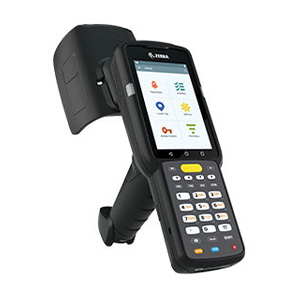
Zebra MC3300 RFID Mobile Computer (Extended Range)
Part #: MC339U-GE3EG4US (MC339XR — extended range)
Extended-range variant of the MC3300 RFID with linear antenna for long-range tag capture in light industrial, warehousing, and manufacturing applications. Reads tagged assets at significantly greater distances than the standard range model — right for scanning high-racking locations, large staging areas, or any application where items are not within close range. Same rugged Android platform and Mobility DNA ecosystem as the standard range model. SE4850 extended range 1D/2D imager for barcode reading at distance as well.
Shop the MC339XR Extended Range →A Practical Phased Implementation Approach
The most common implementation mistake mid-sized manufacturers make with RFID is trying to deploy everywhere at once. A phased approach that starts with one high-impact use case, proves the ROI, and builds operational familiarity before expanding almost always outperforms a broad deployment — both in terms of financial return and worker adoption.
Phase 1 — Single High-Value Use Case (3-6 months)
Choose the one application from the list above where your current manual process is most painful and the ROI case is clearest — typically WIP tracking, tooling management, or shipping verification. Deploy the minimum hardware needed to prove the use case: one or two fixed readers, the appropriate antenna coverage, an RFID-capable printer at the labeling point, and the integration work to connect reads to your existing system. Measure the result. Document the time savings. Use that proof to justify Phase 2.
Phase 2 — Expand Coverage (6-18 months)
With a proven use case and an operational team that understands RFID, expand to additional zone transitions, add handheld reading for cycle counting, and extend tagging to more asset categories. This phase benefits from the infrastructure already deployed in Phase 1 and typically requires proportionally less integration work because the middleware and ERP connections are already established.
Phase 3 — Full Facility Visibility (18+ months)
Full facility RFID coverage — real-time location visibility of every tagged asset, automated inventory reconciliation, item-level production tracking — is the end state that delivers the transformational operational visibility RFID promises. It is best reached as Phase 3, after the organization has developed the operational discipline, system integrations, and institutional knowledge that make it sustainable.
Frequently Asked Questions: RFID in Mid-Sized Manufacturing
Do we need to replace our existing barcode infrastructure to deploy RFID?
No. RFID and barcode can and should coexist, especially during a phased deployment. The Zebra MC3300 RFID mobile computer reads both RFID tags and barcodes in a single device. The ZT411 and ZT421 RFID printers print both a human-readable barcode and an encoded RFID inlay on the same label. You can extend RFID coverage incrementally without abandoning existing barcode workflows in areas where RFID infrastructure isn't yet deployed.
What read range can we expect from a fixed RFID reader in a manufacturing environment?
Practical read range in a manufacturing environment varies significantly based on antenna type, tag placement, and RF conditions. In a relatively open, low-metal environment, a well-configured UHF RFID system can reliably read tags at 15–30 feet from the antenna. In a metal-dense or RF-noisy environment, practical read range may be closer to 6–15 feet. The Zebra FX9600's superior sensitivity (-86 dBm) provides maximum read range and reliability under challenging conditions. A proper site survey and antenna placement plan is the best way to set accurate range expectations for your specific facility.
Can RFID tags survive our manufacturing environment — heat, solvents, abrasion?
Standard paper RFID labels are not appropriate for harsh manufacturing environments. Zebra and other tag manufacturers produce RFID tags in durable substrates — polyester, polypropylene, metal-mount formats — rated for temperatures up to 150°C or higher, chemical exposure, and physical abrasion. The key is matching the tag specification to the application environment. Tags for tooling that goes through wash-down cycles, for example, require different specifications than tags on cardboard cases moving through a clean warehouse. Advanced Automation can help match the right tag specification to your environment.
How does RFID connect to our ERP system?
The most common integration path is through middleware that translates RFID read events into transaction records in your ERP. Zebra's readers use standard protocols (LLRP, REST APIs) that most middleware platforms support. Some ERP systems — particularly newer cloud-based platforms — have native RFID connector modules. The integration complexity and cost depend heavily on which ERP you run and how it handles inventory transactions. This is the item to investigate first in your deployment planning, before hardware selection, because it often drives more of the total project cost than the readers and printers.
We're not sure RFID is right for us yet. What's the lowest-risk way to evaluate it?
Start with a single, bounded use case. Tool crib management or a single dock door receiving verification point is a common first deployment for manufacturing operations evaluating RFID for the first time. A single FX7500 fixed reader, a small number of test tags applied to assets in that area, and a basic read-event logging setup can demonstrate real-world performance in your specific environment before any significant infrastructure investment. Advanced Automation's team can help structure a proof-of-concept scope that answers the right questions with minimal initial outlay.