
Epson ColorWorks Printer Portfolio: The Ultimate Guide to On-Demand Label Printing
Posted by Advanced Automation on Nov 17th 2025
Is On-Demand Color Label Printing Right for Your Business?
In the fast-paced world of manufacturing, logistics, and retail, labels are more than just stickers—they're a critical tool for branding, compliance, and operational efficiency. For years, many businesses relied on outsourcing their color label printing to commercial houses, but as market demands change, so too must printing strategies.
If you’re considering bringing label production in-house, you’re likely grappling with some critical questions:
- Are we losing money by outsourcing? Could the cost of buying in bulk and managing label inventory be higher than the total cost of ownership (TCO) for an in-house Epson ColorWorks printer?
- Is our current two-step process slowing us down? If you're buying pre-printed labels and then adding variable data or barcodes with a separate black-and-white thermal printer, you're dealing with "two touches," which introduces potential for errors, more labor, and wasted time. Can a single-pass color solution eliminate this costly step?
- Has our volume or product mix increased significantly? Are you now managing dozens or hundreds of different SKUs (Stock Keeping Units), different label designs, or constantly changing regulatory information? Outsourcing becomes complex and expensive when run-lengths are short and variability is high.
- Do we need high-quality, durable color labels on-demand? Is your brand image suffering from low-resolution black-and-white labels, or do you need labels that can withstand moisture, chemicals, or extreme temperatures?
If any of these questions resonate with your operation, the answer might be found in the Epson ColorWorks printer portfolio—a line of on-demand industrial color label printers designed to address these modern business challenges head-on.
Why Epson ColorWorks is the Clear Leader in On-Demand Color Label Printing
Epson, a global technology leader, has established its ColorWorks line as the industry benchmark for dependable high-quality in-house color label printing. While the technology has been around for some time, Epson has continually invested in its core technology, the PrecisionCore TFP printhead, to deliver industrial-grade performance.
Epson ColorWorks printers are positioned as a seamless, high-value color upgrade to thermal transfer printers. They offer similar connectivity options (including ZPL II compatibility) and durability, but with the game-changing addition of vibrant, high-resolution color. This eliminates the need to manage separate inventories of pre-printed labels and black ribbons, simplifying the entire workflow into a single, efficient, on-demand process. The printers use Epson UltraChrome DL pigment inks, which are specifically engineered for durability and often achieve BS 5609 certification for resistance to water, chemicals, and fading, making them suitable for GHS and other harsh-environment labeling.
The Epson ColorWorks Printer Portfolio
The ColorWorks printer lineup is structured to provide a perfect fit for operations ranging from low-volume, high-mix applications to high-speed batch runs.
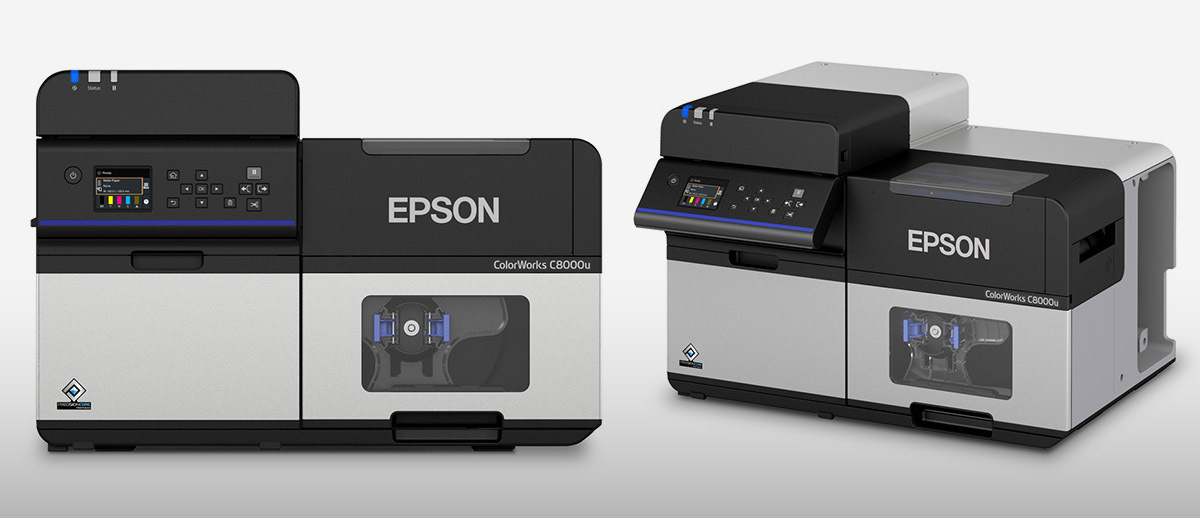
High Volume Printer: CW-C8000 (4" wide)
The Epson CW-C8000 Printer is the flagship model for businesses with demanding, high-volume production requirements. It is an evolution of Epson's high-speed platform, engineered for sheer throughput and efficiency.
Core Functionality & Specifications:
- Volume: High-volume batch printing.
- Max Print Width: Up to 4.25 inches (108 mm).
- Max Print Speed: Up to 11.8 inches per second (ips) at 1200 x 600 dpi. This makes it one of the fastest color inkjet label printers in its class.
- Resolution: Up to 1200 x 600 dpi.
- Connectivity: Ethernet, USB 3.0/2.0, with optional Wi-Fi.
- Unique Functionality: It uses high-yield 1.9 L total ink capacity tanks (one for each CMYK color), which significantly reduces the frequency of ink changes and lowers the overall cost per milliliter of ink. It includes a built-in auto cutter.
The Bottom Line: The CW-C8000 is the solution for companies where speed is paramount and downtime for changing consumables is a major concern. If you need to print tens of thousands of labels quickly in large, frequent batches, and require the lowest possible running cost for consumables, the high-speed, high-capacity C8000 is your workhorse.

Mid to High Volume: CW-C6000 Series (Auto Peeler & Auto Cutter)
The Epson CW-C6000 Series is designed as a direct, seamless color upgrade to existing black-and-white thermal transfer printer installations. They share the same core engine, offering a choice of width and dispensing mechanism.
CW-C6000P (4" wide) & CW-C6500P (8" wide) with Auto Peele
The 'P' models are the first color inkjet label printers to include a built-in peel-and-present function (auto peeler).
Core Functionality & Specifications:
- Volume: Mid- to high-volume applications.
- Max Print Width: CW-C6000P is 4.25 inches (108 mm); CW-C6500P is a wide-format 8.34 inches (212 mm).
- Max Print Speed: Up to 5 inches per second (ips).
- Resolution: Up to 1200 dpi with variable droplet sizes for exceptional quality.
- Connectivity: Ethernet and USB 2.0.
- Unique Functionality: The Auto Peeler automatically separates the label from the liner and presents it for application, dramatically improving efficiency for manual application. This is ideal for manufacturing, kitting, and product assembly lines. The CW-C6500P’s 8-inch width is a key differentiator, enabling the printing of larger GHS drum labels, pallet labels, or two 4-inch labels side-by-side.
The Bottom Line: If your labels are manually applied or if you need wide-format (8-inch) labels, the CW-C6000P Printer/CW-C6500P Printer models are the perfect fit. The peeler eliminates the manual, time-consuming step of label separation, directly improving assembly or packing line productivity.
CW-C6000A (4" wide) & CW-C6500A (8" wide) with Auto Cutter
The 'A' models are equipped with an integrated Auto Cutter.
Core Functionality & Specifications:
- Volume: Mid- to high-volume applications.
- Max Print Width: CW-C6000A is 4.25 inches (108 mm); CW-C6500A is 8.34 inches (212 mm).
- Max Print Speed: Up to 5 ips.
- Resolution: Up to 1200 dpi.
- Connectivity: Ethernet and USB 2.0.
- Unique Functionality: The Auto Cutter allows for variable-length label printing and easy job separation, even when using continuous media. This is essential for printing a diverse queue of different-sized labels on the same roll without waste. Like its 'P' counterpart, the CW-C6500A Printer offers a distinct advantage with its 8-inch wide format.
The Bottom Line: The CW-C6000A Printer/CW-C6500A Printer models are the go-to choice for batch printing different SKUs where the labels will be collected for later application or for printing on continuous stock that needs precise, individual cuts. The auto cutter streamlines post-print handling for batch jobs.
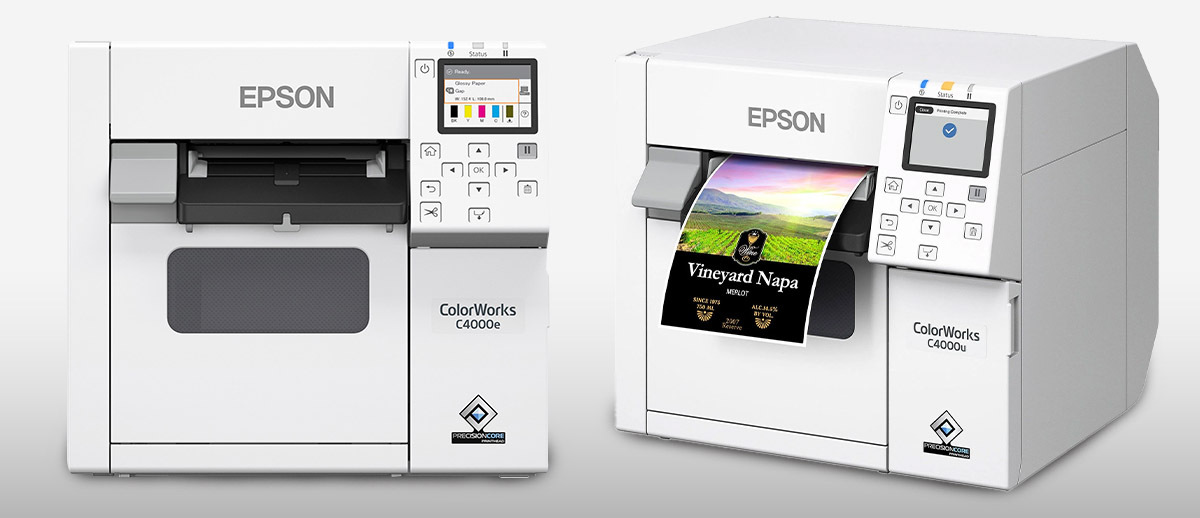
Low to Mid Volume: CW-C4000 (4" wide)
The Epson CW-C4000 Printer is the most compact and accessible entry point into the Epson ColorWorks family, designed to replace older desktop black-and-white printers.
Core Functionality & Specifications:
- Volume: Low- to mid-volume applications.
- Max Print Width: Up to 4.25 inches (108 mm).
- Max Print Speed: Up to 4 inches per second (ips).
- Resolution: Up to 1200 dpi.
- Connectivity: Ethernet, USB 2.0, with an optional Wi-Fi module.
- Unique Functionality: Its compact design allows it to fit easily into almost any work environment, making it perfect for smaller warehouses, satellite offices, or retail counters. It maintains the high 1200 dpi resolution of its larger siblings, ensuring the brand and quality image is never compromised.
The Bottom Line: The CW-C4000 is the cost-effective solution for businesses taking their first step into on-demand color or those with lower daily print volumes. It offers a small footprint without sacrificing the high-quality, durable color capabilities of the ColorWorks line.
Understanding Inkjet vs. Thermal Transfer Printing
Epson ColorWorks printers use specialized inkjet media, which is fundamentally different from the media used in traditional thermal transfer printing.
How ColorWorks Inkjet Technology Work
The Epson ColorWorks line utilizes PrecisionCore Heat-Free Technology. Unlike traditional thermal inkjet systems that use heat to eject ink, the PrecisionCore printhead uses a piezoelectric element—a tiny crystal that flexes when an electrical charge is applied. This flexing precisely controls the firing of perfectly sized, microscopic droplets of liquid ink onto the specially coated label substrate.
The ink used is Epson UltraChrome DL Pigment Ink. Pigment-based inks consist of solid color particles suspended in a liquid. Once printed, the solvent in the ink evaporates, and the solid color pigment bonds to the receptive layer of the inkjet paper or film. This process delivers labels that are instantly durable, highly resistant to smudging, smearing, and fading, and can pass the rigorous BS 5609 durability test, which is necessary for Durable Color Label Printing like GHS labeling.
Inkjet vs. Thermal Transfer: Which is Better
Neither printing method is inherently "better," but one is certainly superior for specific applications.
- Thermal Transfer: This method uses a heated printhead to melt a wax or resin ribbon onto the label material. It is a highly robust method, ideal for monochrome (black-and-white) barcodes and serial numbers where durability and simple text/line work are the only requirements. The main drawbacks are the limitation to one color per ribbon and the two-step process required for pre-printed color labels.
- ColorWorks Inkjet: This method is superior when full-color branding, photo-quality images, regulatory compliance color-coding, and on-demand variable data in color are required. It combines all data and color into a single pass. While high-volume thermal printers might offer higher raw black-and-white speed, the ColorWorks line provides high speed in full color, eliminating the costly two-step process, which often translates to greater overall productivity.
Material Versatility and Durability
One of the most powerful advantages of ColorWorks technologies is the flexibility it provides in media selection, allowing end-users to precisely manage cost versus durability requirements.
For applications that do not require high durability—such as short-term promotional labels, internal color-coded inventory tags, or receipts—a customer can leverage less expensive standard paper inkjet label material. This keeps consumable costs down while still enjoying the benefits of in-house color printing.
On the other end of the spectrum, for highly demanding environments that require hot/cold, moisture, chemical, or abrasion resistance, the customer can move to synthetic ink jet material (like polypropylene or vinyl). When combined with the durable UltraChrome DL pigment ink, these labels can achieve industrial-grade longevity, such as the aforementioned BS 5609 certification. The ability to print durable, full-color labels on-demand, like large GHS Labels, is a major reason businesses switch from outsourcing or complex two-step processes. While durability comes at a cost, having the flexibility to choose the right material for the job is a huge operational and cost-management advantage.
Common Applications and Industries
On-demand color printing has delivered significant efficiency, productivity, and savings across numerous industries.
- Food and Beverage: Printing vivid, branded product labels and nutrition fact panels that must be updated frequently for new flavors or regulatory changes.
- Chemical/GHS Labeling: Creating compliant Durable Color Label Printing with the required red diamond pictograms for GHS (Globally Harmonized System) chemical safety.
- Retail/E-commerce: Generating unique promotional labels, price-markdown labels, and product-specific labels for small batches of high-end or seasonal goods.
Healthcare/Pharmaceutical: Printing accurate, color-coded patient wristbands, specimen labels, and prescription labels where color is used for quick and accurate identification to prevent errors. - Manufacturing/Logistics: Producing color-coded inventory, kitting, and work-in-progress (WIP) labels to visually streamline complex assembly lines and track parts.
- Private Labeling: Printing small runs of different client labels with unique branding and variable data for each job, all in-house.
ColorWorks vs. The Competition
When objectively comparing Epson ColorWorks to competing brands like the Zebra Color Printer or other industrial inkjet manufacturers, a few clear distinctions emerge across key criteria.
Overall Printer Functionality and Capabilities
Epson’s strength lies in its PrecisionCore TFP printhead technology, which is permanent and does not require frequent replacement, leading to long-term cost savings and reduced maintenance. The entire portfolio is built for seamless integration, featuring native ZPL II and ESC/Label compatibility, which is crucial for replacing incumbent black-and-white thermal printers without expensive programming changes. While competitors offer viable solutions, Epson is often cited for its superior combination of high print resolution (1200 dpi) and fast speeds across the mid-to-high volume range (C6000 and C8000 series).
Price Point and Total Cost of Ownership (TCO)
The initial price point for Epson ColorWorks printers is comparable to or slightly higher than entry-level competitors, reflecting their industrial-grade build. However, where Epson truly competes is on the Total Cost of Ownership (TCO). The large, high-yield ink cartridges in the C6000 and C8000 series offer one of the lowest ink costs per milliliter in the industry. Furthermore, the permanent printhead (unlike disposable printheads used by some competitors) significantly reduces the cost for supplies and printer parts over the lifetime of the unit, delivering long-term savings.
Service and Support After the Sale
Epson offers a robust network of authorized resellers and service providers. The standard warranty is backed by optional Spare-in-the-Air (SITA) or On-Site Extended Service Plans. This focus on providing whole-unit exchange or rapid on-site support for mission-critical applications is a strong selling point, ensuring minimal downtime compared to competitors that may only offer depot or return-for-repair services. The reliability of the PrecisionCore technology also inherently reduces the need for service interventions.
While competitors offer good machines, Epson ColorWorks maintains its leadership by providing a superior TCO, industry-leading print quality (1200 dpi), and an unparalleled feature set like the Auto Peeler and 8-inch wide format options, all while maintaining the industrial durability and integration capabilities expected by businesses transitioning from thermal transfer technology.