
What Is a Good Warehouse Inventory Accuracy Rate? Benchmarks, Real Costs, and What It Takes to Get There
Posted by Advanced Automation on Sep 14th 2026

By Advanced Automation, Inc. | Warehouse Operations | Inventory Accuracy Benchmarks 2026
Inventory accuracy is one of those metrics that feels abstract until you see what it costs in concrete terms. Unfillable orders, incorrect picks, emergency reorders, excess cycle count labor, and supplier chargebacks are all downstream symptoms of an inventory accuracy problem. Understanding where your operation sits relative to realistic benchmarks is the starting point for knowing whether the problem is worth addressing and what it would take to fix it.
What Is Inventory Accuracy and How Is It Calculated?
How do you calculate warehouse inventory accuracy?
Inventory accuracy is the percentage of inventory records in your WMS or inventory management system that match physical stock. The formula is straightforward: divide the number of counted locations or SKUs with correct quantities by the total locations or SKUs counted, then multiply by 100.
The tricky part is defining what counts as correct. Some operations use exact match, meaning any quantity discrepancy flags the record as inaccurate. Others use a tolerance band, accepting records within plus or minus a small percentage of the system quantity. The tolerance decision significantly affects your calculated accuracy rate and makes comparing your number to external benchmarks complicated unless you know how those benchmarks were calculated.
For most practical purposes, use exact match for high-value, regulated, or customer-facing inventory where discrepancies have direct financial or compliance consequences, and use a reasonable tolerance band for bulk or low-value stock where minor discrepancies have minimal impact. The goal is a number that reflects operational reality, not one that's been made to look good through a generous tolerance definition.

What Is a Good Warehouse Inventory Accuracy Rate?
What do the benchmarks actually say?
Here is what current research shows, presented without the inflated numbers that vendors sometimes use to make improvement look more dramatic than it is.
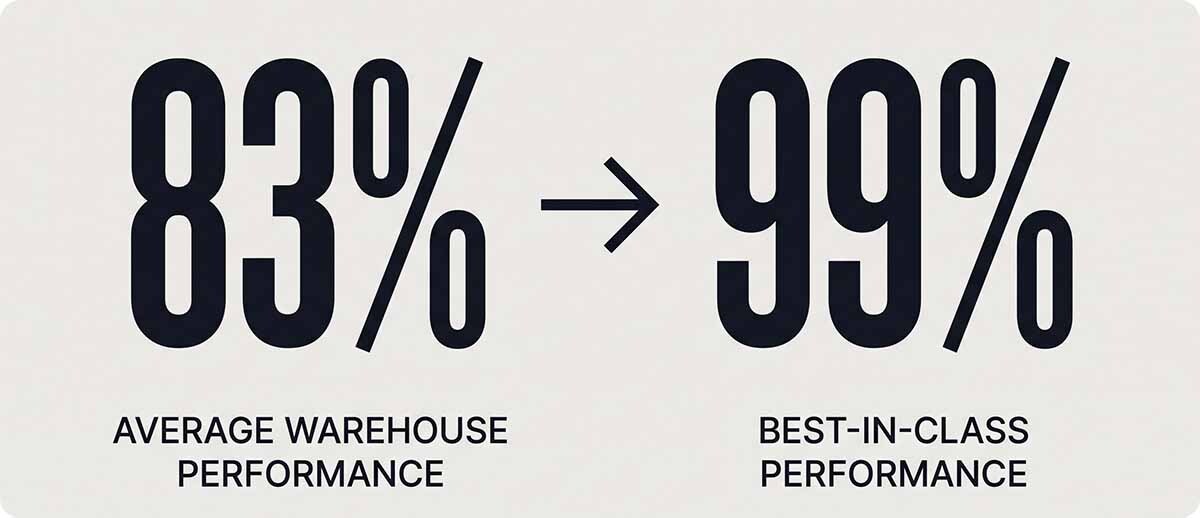
Average accuracy across warehouse operations: approximately 83 percent. CAPS Research, summarized by the Institute for Supply Management, found an average inventory accuracy rate of 83 percent across warehousing operations. Notably, only 69 percent of companies track the metric at all, meaning many operations are managing inventory without a reliable measure of how accurate their records actually are.
Operations on manual entry or poorly maintained scanning workflows: 63 to 85 percent. Research on warehouses relying on manual data entry or inconsistent scan practices consistently shows accuracy in this range. The variance depends on staff discipline and the complexity of the operation, but manual processes fundamentally cannot achieve the accuracy rates that systematic barcode scanning produces.
Median warehouse: approximately 97 percent. Warehousing Education and Research Council (WERC) data puts the median warehouse at roughly 97 percent inventory accuracy. This is the midpoint, meaning half of measured warehouses are above this and half are below.
Good accuracy: 99 percent and above. WERC benchmarking research places 99 percent as the threshold for good accuracy performance. Operations in the top 20 percent of WERC benchmarking sustain 99.8 percent or higher.
Best-in-class for regulated industries: 99.5 percent and above. For food and beverage, pharmaceutical, medical device, and automotive operations where traceability and compliance requirements impose stricter accuracy demands, 99.5 percent is the practical minimum for sustainable operations without regular compliance events.
Why does 99 percent still produce a lot of errors?
This is the part of inventory accuracy benchmarking that surprises most operations managers when they see it written out. At 99 percent accuracy, an operation with 100,000 inventory records still has 1,000 inaccurate records in the system at any given time. At 100,000 orders per year with 99 percent picking accuracy, that's mathematically around 1,000 order errors annually. The percentage sounds excellent. The absolute error count sounds different.
This doesn't mean 99 percent isn't worth pursuing. It absolutely is. It means the target accuracy rate for your operation should be set based on your transaction volume and the cost of each error event, not just on what benchmark percentages look impressive in a report. A low-volume specialty operation with high-value inventory may need 99.9 percent. A high-volume commodity warehouse where individual error costs are low may function well at 98 percent. The benchmark is context-dependent.
What Does Poor Inventory Accuracy Actually Cost?
How do you put a dollar figure on inventory inaccuracy?
IHL Group research found that inventory distortion, the gap between what systems say and what shelves hold, costs retailers approximately $1.77 trillion annually across global operations. That figure is global and includes both overstocks and stockouts, but it illustrates the scale of the problem at the macro level.
At the individual operation level, the cost shows up in several line items that most operations track separately and don't connect to inventory accuracy as a root cause. Emergency reorders when in-stock items show as short. Unfillable orders and lost sales when system-available items aren't physically there. Incorrect picks that generate returns, replacements, and chargebacks. Excess cycle count and reconciliation labor. Supplier compliance chargebacks when labeling or quantity requirements aren't met consistently.
Research consistently finds that a one percent improvement in inventory accuracy produces measurable gains in gross margin, working capital efficiency, and cash flow, not because the numbers are theoretical but because the downstream error events that consume labor and generate chargebacks are reduced in direct proportion to the accuracy improvement.
What Does It Actually Take to Get to 99 Percent?
What is the gap between 83 percent and 99 percent, and how do you close it?
The gap between average accuracy (approximately 83 percent) and good accuracy (99 percent) is almost entirely explained by three factors: how inventory transactions are recorded, how consistently scanning workflows are followed, and how quickly discrepancies are identified and corrected. None of these require exotic technology. They require the right tools being used the right way, consistently.
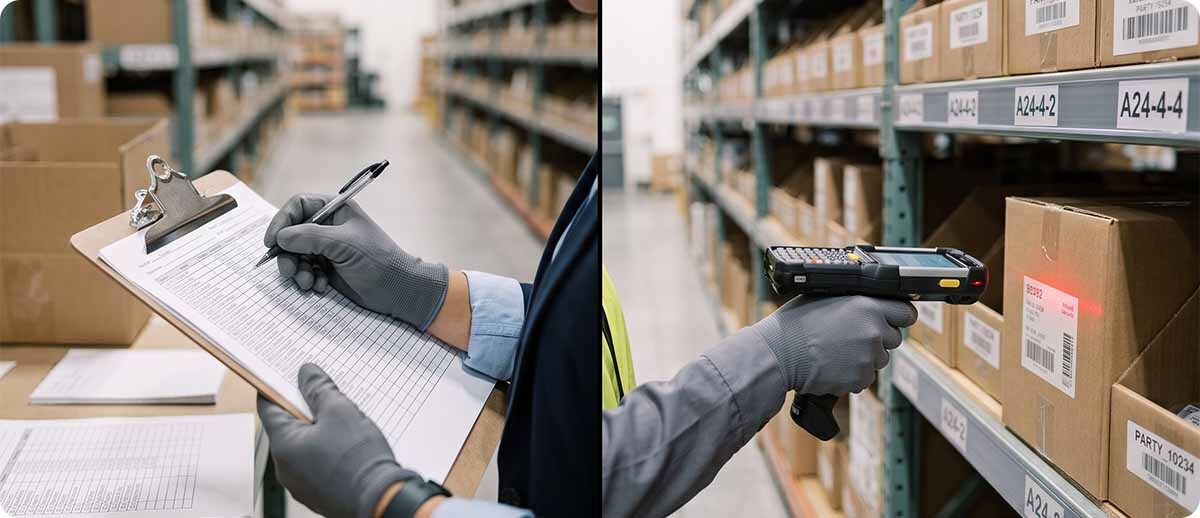
Eliminating manual data entry from inventory transactions. Manual entry is the single highest-error-rate inventory recording method. A worker typing a quantity or SKU introduces transcription errors at a rate that no training program can reduce to zero. Every manual entry is an opportunity for a data quality event. Replacing manual entry with barcode scanning at every inventory touch point, receiving, putaway, picking, cycle count, and shipping, eliminates that error source systematically rather than managing it through supervision.
Scan compliance at every transaction. Barcode scanning only improves accuracy when workers actually scan rather than assume, override, or skip the scan step. Scan compliance, the percentage of transactions where a barcode scan actually occurs versus assumed or manually entered, is one of the most important process metrics in a barcode-enabled warehouse. Operations with high scan compliance consistently outperform those where scanning is inconsistent, even when using the same hardware.
Hardware that doesn't create scan failures. Worn scanners with degraded read rates, damaged labels that don't scan reliably, and mobile computers with failing batteries that drop mid-session all create scan failures that workers work around rather than report. Those workarounds are where manual entry creeps back in and where accuracy erodes. Maintaining hardware in working condition and replacing devices before they drive workers to bypass the scan step is not optional for operations targeting 99 percent accuracy.
Real-time discrepancy identification. Operations that catch inventory discrepancies at the point of transaction, when a picked quantity doesn't match the system, or when a received shipment doesn't match the PO, resolve them immediately with accurate data while the context is still clear. Operations that batch these discrepancies and address them in periodic cycle counts are working with stale information and typically find more cascading errors than root cause problems.
The Hardware Side of Inventory Accuracy
What barcode hardware has the most direct impact on inventory accuracy?
The hardware that most directly affects inventory accuracy is whatever is in the hands of the worker recording each inventory transaction. A mobile computer running a WMS application with barcode scan confirmation built into every transaction step is the standard for operations achieving 99 percent accuracy. The scan confirmation step is the mechanism that prevents assumed picks, quantity shortcuts, and manual overrides from entering the system as accurate records.
Zebra's TC53 and TC73 are the two most widely deployed mobile computers in warehouse inventory management for operations in this accuracy tier. The TC53 handles standard warehouse distances and indoor workflows. The TC73 adds extended range scanning up to 40 feet and a higher drop rating for more demanding physical environments. The TC501 adds built-in RFID for operations implementing RFID inventory management, which produces accuracy improvements beyond what barcode scanning alone achieves by enabling faster, non-line-of-sight inventory reads.
Dedicated barcode scanners, the Zebra DS3608 and DS3678 for fixed stations and demanding environments, complement mobile computers in workflows where a separate scan device is preferred. For operations measuring scan compliance and finding that workers are frequently skipping the scan step due to scan failures on difficult-to-read labels, worn scanner read rates, or awkward scan positions, the CS60 companion scanner pairs with a mobile computer to add a trigger-based scan option that reduces scan friction and improves compliance.
Hardware commonly associated with 99 percent inventory accuracy
Mobile computers: Zebra TC53, TC73, TC501, MC9400 depending on environment and RFID requirements
Dedicated scanners: Zebra DS3608, DS3678, CS60 companion scanner
Label quality: Zebra Z-Select, Z-Perform, Z-Ultimate depending on environment and lifespan requirements
Fleet management: Zebra DNA Cloud for scan compliance visibility, device health monitoring, and proactive hardware maintenance
Shop Mobile Computers at AA →Quick Questions
Our cycle counts show we're at about 95 percent. Is that good enough?
It depends on your operation's error cost profile. At 95 percent, a warehouse with 50,000 inventory records has 2,500 inaccurate records in the system at any time. Whether that's acceptable depends on what those errors cost when they surface: returns, chargebacks, emergency reorders, and lost sales. For most operations with meaningful customer-facing fulfillment requirements, 95 percent generates enough downstream error events to justify the investment in closing the gap. WERC benchmarking puts 99 percent as the target for good performance, meaning 95 percent is materially below where well-run operations land.
We scan everything. Why is our accuracy still low?
Scanning everything is necessary but not sufficient. The most common culprits in operations with scanning deployed but persistent accuracy problems are scan compliance issues where workers bypass the scan step in certain workflows, label quality problems where scan failures prompt manual override entries, worn hardware that produces intermittent scan failures, and WMS configuration issues where scanned data isn't flowing correctly into the inventory record. We cover these in detail in our separate guide on the 10 causes of barcode data errors. If you're scanning and still seeing accuracy problems, the cause is almost always in one of those categories.
How long does it take to move from 85 percent to 99 percent accuracy?
Operations that address the root causes systematically rather than incrementally typically see significant accuracy improvements within one to three months of implementation. The speed depends on how many root causes are in play and how quickly the corrective hardware and process changes can be deployed. Operations that replace manual entry with scanning at high-frequency transaction points like receiving and picking typically see the fastest accuracy gains because those transaction types generate the highest error volumes. If you want to talk through what the fastest path looks like for your specific operation, fill out the form below.
If you want to know where your operation sits relative to these benchmarks and what specific hardware or process changes would have the most impact on your accuracy number, fill out the form below. We can usually identify the highest-leverage opportunities quickly once we understand your current workflows and where your scan failures are occurring.